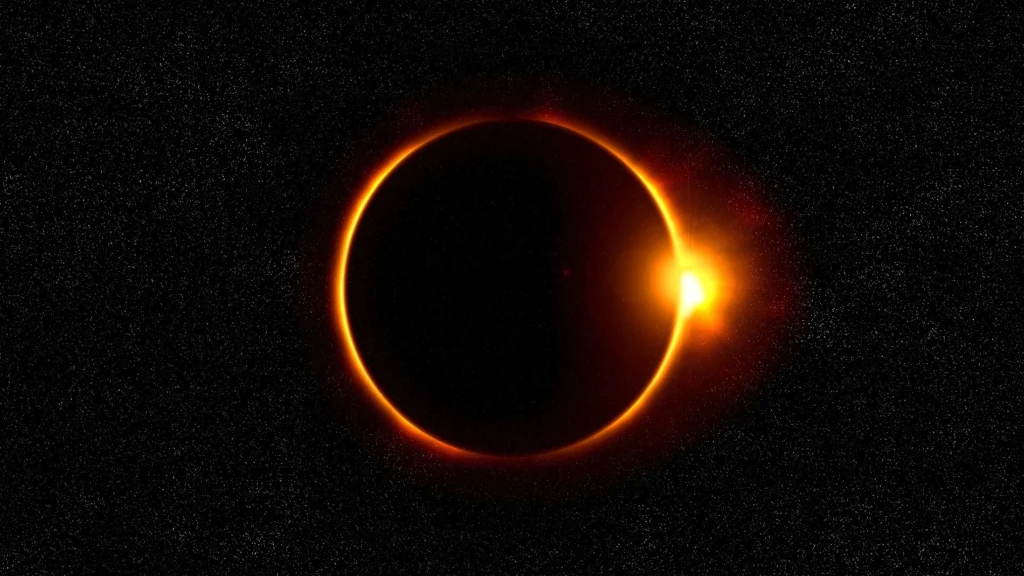
Total solar eclipse in Mallorca
August 12th 2026 Mallorca will experience a rare and incredibly fascinating phenomenon — a total solar eclipse. This means that the moon will completely cover the sun and, for a short while, the island will be submerged in night-like darkness.
The eclipse will start in the evening, closer to sunset. At first, the sun will be gradually obscured by the moon, until it reaches the final phase for around one and a half minutes. At that point the sky will noticeably darken, the temperature might fall, stars will appear, and the solar corona — a luminous glow — will become visible around the moon’s black disk. After this, the sun will begin to reappear and soon set below the horizon.
The special thing about this eclipse in Mallorca is that it will happen very close to the horizon — almost at sunset. Therefore, for proper observation it is important to choose a place with an open view to the west, for example by the sea or on a hill.
Such events rarely happen in the same place, which makes this an excellent opportunity to witness one of the most beautiful natural phenomena. Most importantly, don’t forget about safety measures and use special protective glasses, except for the short moment of the final phase.
There are a few more interesting, less obvious details about this eclipse that make it truly special.
Firstly, it’s part of a so-called Saros cycle — a series of recurring eclipses that occur approximately every 18 years. This particular eclipse is part of a series that gradually “shifts” across the Earth’s surface. And in 2026, the trajectory passes through Spain, placing Mallorca in a nearly perfect area for observation.
Secondly, due to the sun being very close to the horizon, the visual effect will seem truly special:
The sun may seem larger and more red due to the atmosphere. Alongside the eclipse it creates an almost surreal image — the dark disk of the moon against the warm sunset sky.
Another rare feature are so-called “shadow waves”. A few seconds before the full phase and right after it, fast-moving, wavy shadows, similar to ripples in water, may appear on the ground. They’re difficult to spot, but if you’re looking at a light-coloured surface (such as a wall or sand), you might be able to spot them.
You can also witness the “diamond ring” effect when the last bright ray of sunlight shines like a precious stone on the edge of the moon. This takes place seconds before complete darkness and right after it.
It is interesting how animals often react to the eclipse: birds may fall silent or start to behave as if it were evening, while insects, on the contrary, become more active. This creates a feeling that day has suddenly turned to night.


